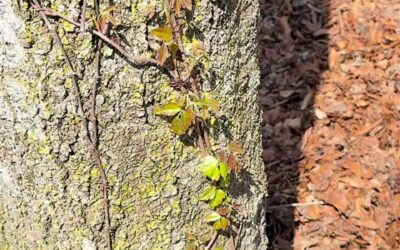
Field Note: The Project That Changed My Process
This was one of my first larger poison ivy removal projects, and it taught me a lot.
The plant was not tucked away in the woods. It was wrapped around an entry point. That meant the risk was not only the plant itself. It was the repeated contact: sleeves, hands, shoes, tools, delivery bags, pets, packages, and the door area.
I started Remove My Poison Ivy in September of 2017. I do not remember the exact month of this job, but it was early enough that I was still learning what it would actually take to do this work as a service, not just as a one-time removal.
This project is one of the reasons I started taking PPE, exposure control, and cleanup procedures much more seriously.
I was covered. I was protected. But time became a major factor. The longer I worked, the more I realized that clothing, gloves, tools, sweat, movement, and takedown all mattered. It was not enough to just put gear on and start pulling.
I did not have a severe reaction from this project, but I knew afterward that I had to rethink everything.
How I suited up.
How long I stayed in a removal.
How I handled tools.
How I removed contaminated clothing.
How I cleaned up afterward.
How I protected myself enough to keep doing this work and still be healthy at the end of the job.
That project changed how I looked at poison ivy removal.
It made it clear that removal is not just about getting the plant out of the ground. It is about managing exposure, oil transfer, contaminated surfaces, and the entire setup and takedown process.
That is the part many people miss.
Poison Ivy Field Notes:
Real examples, seasonal observations, and removal notes from poison ivy projects around the Rochester, NY area.