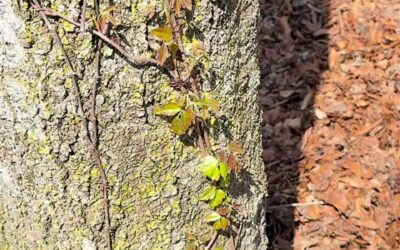
Box elder is one of the plants people commonly mistake for poison ivy, especially when it is young.
At first glance, it can have three leaflets and a similar shape. But the stem pattern usually gives it away.
Poison ivy grows in an alternating pattern along the stem. Box Elder usually grows in opposite pairs, with each leaflet coming out from one another.
The Basics of Poison Ivy Identification
Poison ivy (Toxicodendron radicans) is commonly recognized by its clusters of three leaflets. These leaflets can have smooth, toothed, or lobed edges and change color with the seasons. In spring, they are reddish; in summer, they are green; and in fall, they can be yellow, orange, or red.
However, poison ivy’s appearance can vary significantly, making it tricky to identify. Here are some key features:
Leaf Arrangement – Clusters of three leaflets.
Leaf Shape – Can be smooth, toothed, or lobed.
Color Changes – Reddish in spring, green in summer, yellow/orange/red in fall.
Growth Pattern – Can grow as a vine, shrub, or ground cover.
Alternating on the vine – The leaf clusters do not sit directly across from each other. They alternate along the stem. Each “leaf” is made up of three leaflets.

BOX ELDER – NOT POISON IVY
Field Notes: Poison Ivy Look-Alikes
Box Elder
Young box elder is one of the easiest plants to confuse with poison ivy because it can show three leaflets at the end of a stem. The better clue is the stem pattern. Box elder leaves usually grow opposite each other, with pairs coming out across from one another. Poison ivy grows in an alternate pattern, with leaf clusters stepping up the stem one at a time. As box elder matures, the leaves become easier to separate from poison ivy.
Grapevine
Grapevine can be confused with poison ivy because both can grow as climbing vines in brushy edges and wooded areas. The easiest clue is the leaf. Grapevine usually has one larger leaf, often heart-shaped, lobed, or jagged, while poison ivy usually has three leaflets. Grapevine also often has a looser, droopier look in the field, especially where young vines are hanging or sprawling through other plants. It climbs with curling tendrils. Poison ivy climbs with aerial rootlets, which can make older vines look hairy. Be careful in tangled growth, because poison ivy can grow right through grapevine.
Virginia Creeper
Virginia creeper can be mistaken for poison ivy when it is young because it may start with three obvious leaflets before developing the more familiar five-leaflet pattern. In the field, young Virginia creeper often looks thinner, greener, and more flexible, with a more repeated pattern along the vine. The tendrils are a strong clue. Virginia creeper climbs with tendrils, while poison ivy climbs with aerial rootlets that can make older vines look hairy.
Strawberry
Strawberry can be confused with poison ivy because it has three leaflets, but the plant usually behaves very differently. Strawberry stays low, spreads by runners, and often forms small groundcover patches. The leaves are usually smaller, rounder, more toothed, and softer-looking than poison ivy. Flowers and red berries are helpful clues when present, but they are seasonal, so look at the whole plant before deciding.
Blackberry and Raspberry
Blackberry and raspberry can both be mistaken for poison ivy because young leaves may appear in groups of three. The better clue is the stem. These plants are brambles, so the stems often have prickles, bristles, or tiny hair-like thorns, especially on young growth. Poison ivy does not have thorns. The tricky part is that poison ivy can grow through blackberry or raspberry patches, so a thorny stem does not mean the whole area is safe.
Hog Peanut
Hog peanut is a common poison ivy look-alike because it has three leaflets and grows as a vine. The better clues are the softer, more bean-like leaflets and the way the vine twines through nearby plants. Poison ivy usually looks more structured, and when it climbs, it uses aerial rootlets instead of wrapping like a twining vine. Be careful in mixed growth, because hog peanut and poison ivy can grow in the same kind of edges and brushy areas.
Box Elder in the field


Poison Ivy Field Notes:
Real examples, seasonal observations, and removal notes from poison ivy projects around the Rochester, NY area.